
Semtech Deep Dive
Semtech ($SMTC): The Content Number and the Fab That Gates It

Introduction

Semtech guides roughly $80 of content per optical module at 3.2 terabits, up from high single digits at 800G. Everyone quotes the number, but I have never seen anyone break it down. Against published bill-of-materials, it decomposes three ways: $15 to $20 of amplifier, $15 to $20 of driver, and $40 to $50 of laser. The majority of the most-quoted figure in the entire thesis is the light source.
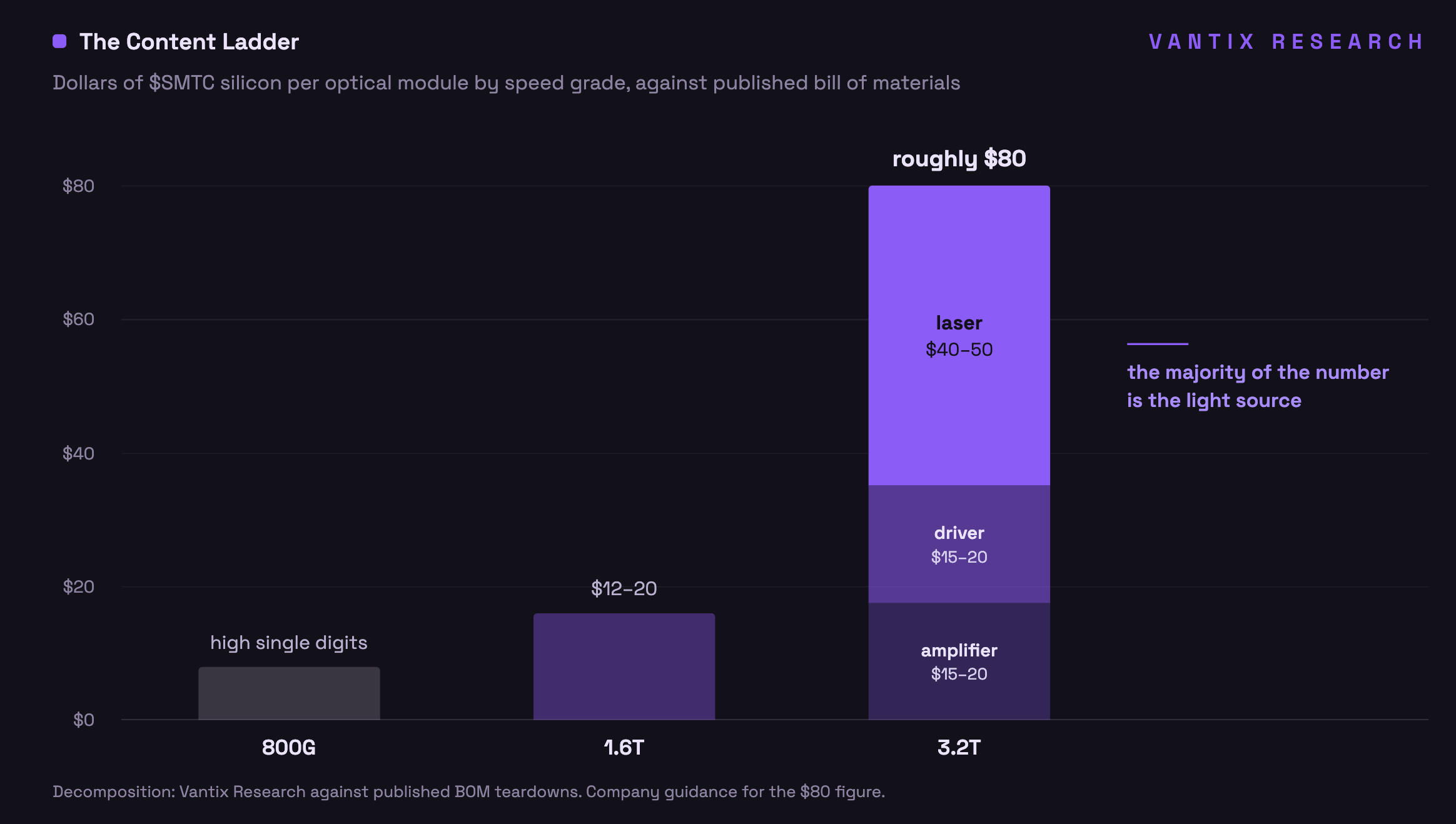
Semtech bought its light source in March. A sold-out laser fab, acquired out of a national-security forced sale for $34 million, by a CEO who used to run the company that built it. Weeks later, the raw material under every laser finished tripling in price, and the category moved to allocation with order books through 2027. The content ladder and the footnote acquisition are the same bet, and the bet was placed at a forced seller’s price right before its world repriced.
If you have never heard of Semtech, here is the thirty-second version: It is a fifty-year-old analog chip company from Camarillo, California. Around a billion dollars of revenue, three businesses, and one skill that matters: keeping extremely fast electrical signals clean using simple analog circuits instead of a DSP, the expensive, hot digital chip the rest of the industry uses to repair a degraded signal. That one skill is currently being pulled into the largest hardware buildout in history.
So place it. Training an AI model does not happen on a chip. It happens on tens of thousands of chips wired together so tightly they behave as one computer, which means the wiring is not plumbing; it is the computer. Google builds its own AI chip, the TPU, its answer to Nvidia’s GPU, and will ship several million of them this year, with supply sold out. Every TPU has to talk constantly to its neighbors, and the traffic moves three ways. Short hops inside a rack go over copper cables, cheap and cool, with a small equalizer chip inside each cable keeping the signal alive. Longer hops between racks convert to light, through optical modules: pluggable devices the size of a pack of gum, one in every port, a few hundred dollars of components each at 800G and roughly double that at 1.6T, tens of millions of units shipping this year. Inside every module, an amplifier and a driver stand guard at the exact point where electricity becomes light and back. And the light itself comes from lasers built on a scarce semiconductor called indium phosphide, the material whose price just tripled.
Semtech sells the equalizer in the cable, the amplifier and driver in the module, and, since March, the laser under the light. Three tolls on the same traffic, arranged so that when one path loses share, the traffic pays one of the other two. On the copper side, the position is stranger than strong: Google engineered its TPU supply chain with a second source at every layer, two chip designers, two packaging houses, three cable makers, and one exception. The equalizer inside the cables is single-sourced to Semtech across all of it. The most redundancy-obsessed buyer in the industry built redundancy around this part and could not build it into the part. Why, and what the new standards body co-chaired by Semtech and its closest chaser does to that position by 2028, is below.
This is a pretty crowded ticker already. It ran from $25 to $177 in around fifteen months, recently pulling back under $120. Most already know the general thesis. The mechanisms below are what you didn’t yet know.
The Physical Layer
One capability generates every product in this thesis: keeping a 200-gigabit-per-second electrical signal intelligible using linear analog circuits instead of a DSP, the digital signal processor that re-times and reconstructs a degraded signal at a cost of several watts and several dollars per lane. Linear analog preserves the raw waveform and cleans it with equalization. It is cheaper, cooler, and lower-latency than digital reconstruction, and it fails abruptly when the channel gets too dirty. The entire company is the exploitation of the region where analog suffices.
Three products apply it at three distances.
